

🔎 DECODED: Perfusion
This one concept connects your CHD child's liver results, exercise tolerance, brain development, and half of what the cardiologist monitors. Here's how to see it.

I need to talk about a word that has been driving me up the wall (remember PLE?).
It keeps showing up in the research papers I read — just casually, mid-sentence:
“bla bla bla… medical stuff… perfusion… something medical happened….”
Cerebral perfusion. End-organ perfusion. Perfusion mismatch.
Clearly it’s part of the Doctor 101 vocabulary because unlike a lot of medical terms (which researchers will usually define, or at least spell out the abbreviation the first time), this one never gets the courtesy of an introduction! It just shows up and expects you to know who it is.
And what makes it worse is that every time I encounter it, I have to look it up. Again! I read the definition, I nod, and then 3 paragraphs later, wouldn’t you know it, it shows up again but this time in a completely different context that means something slightly different, and I realize I don’t actually have it! In one sentence they’re talking about perfusion to the brain, and in another they’re talking about perfusion pressure during surgery, and in another it’s about poor perfusion as a clinical sign, and it’s the same word doing three different jobs and nobody told me which one they meant this time. So now I’m not just looking up a definition — I’m interpreting it on the fly, cross-referencing it against whatever they’re actually discussing, and trying to hold the whole thing together while I’m also trying to understand the study itself. The migraines, guys, the god-forsaken migraines.
It’s exhausting. I didn’t get the Doctor 101 Glossary of Terms. I missed that day… or, you know.. the whole damn course.
But here’s the thing, though: perfusion isn’t actually some impossible concept; it’s not even that complicated once someone sits you down and explains it properly. The problem is that the word gets used as shorthand for six different things depending on context, and nobody hands you the decoder ring. So you’re left nodding along in appointments and squinting at research papers, feeling like everyone else got a memo you missed.
Well, I went and wrote myself the memo. I sat myself down, really gave it a good old College Try, and I finally got it to a point where I can now explain it to you as well. So here we go.
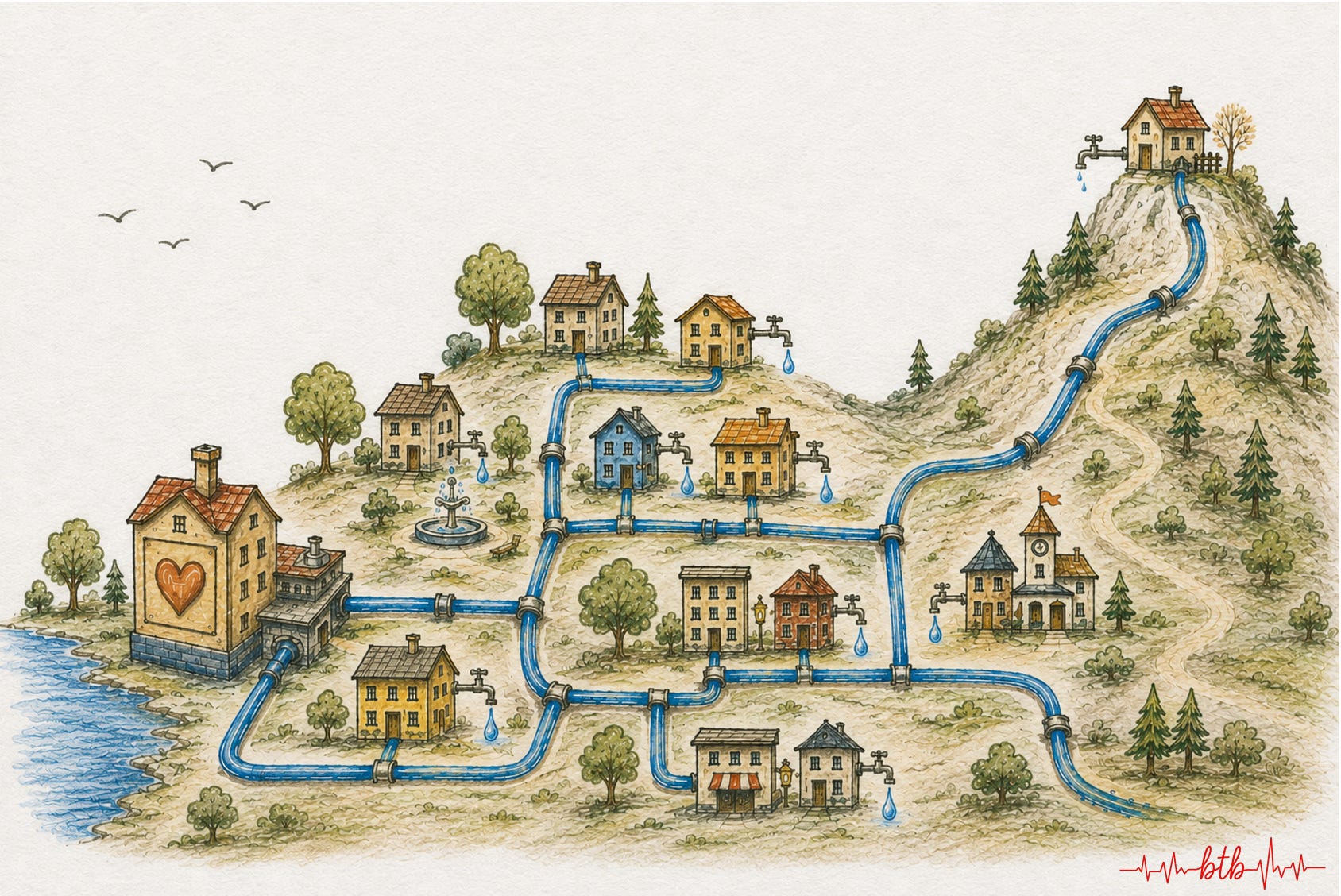
The City
Think of your body as a city. The heart is the municipal water pumping station. The blood vessels are the pipes. Blood is the water (Biblical, I know, but bear with me). Circulation is the whole water system: the infrastructure, the network, the loop that carries water out and brings it back. It’s the map of pipes on the city engineer’s wall.
Perfusion is whether the water is actually reaching every house and every faucet, at enough pressure to be useful.
And this next part is something that I really had to dig into because it kept tripping me up: you can have a perfectly intact pipe network (nothing broken, nothing blocked, every connection in place) and still have houses at the end of the line that aren’t getting enough water.
I can already hear your brain going: “OK but wait, how? If the pipes are fine, why isn’t the water getting there?”
Great question! I asked myself the same thing. Because intact pipes are only half the story; the other half is what the pump is actually doing.
Picture a house at the top of a hill at the very end of a long run of pipe. Every pipe between the pumping station and that house is in perfect condition; no leaks, no blockages, nothing broken. But if the pumping station is only running at half power (say one of its two motors is down), the water pressure drops across the whole system. So the houses closest to the station are going to be fine, sure (they’re first in line, they get enough pressure just from proximity). But that last house at the top of the hill? The water barely trickles out of the tap. Nothing wrong with the pipes… but there’s not enough force behind the water.
That’s perfusion. The infrastructure can be perfectly intact. The problem is whether the pump is generating enough pressure to push blood all the way to the farthest, hardest-to-reach places. So when a cardiologist says “we’re worried about perfusion” or you read a research paper that has the term peppered throughout, what they’re really saying is: “The plumbing exists, but we’re not confident that enough blood is reaching [this organ] to keep it happy.”
And this is why clinicians need the word as a separate concept from circulation, because you can have:
Good pipes, weak pump (good circulation, poor perfusion): Water reaches the main lines but the pressure is too low at the far ends
Some neighbourhoods fine, others running dry (perfusion mismatch): Downtown is well-served; the suburbs are struggling
Adequate pressure on a quiet Tuesday, but not during a heat wave (adequate perfusion at rest, inadequate under demand): The system handles baseline just fine — but when everyone turns on their sprinklers, the houses at the end of the line lose pressure first. This is the exercise intolerance connection, and we’ll come back to it.
So here’s your decoder ring for the next time this word shows up in a paper or an appointment:
“Perfusion pressure” = The water pressure at the faucet (how much force is pushing blood into a specific organ)
“End-organ perfusion” = Are the houses at the end of the line getting water? (is enough blood actually reaching the liver, kidneys, brain, gut)
“Cerebral perfusion” = Blood flow to the brain specifically (the neighbourhood clinicians worry about most)
“Perfusion mismatch” = Downtown’s fine; the outskirts are not
It’s Not Just a Fontan Word
Before we go any further, I want to pause here and highlight something important: perfusion issues show up across many types of congenital heart disease. If your child doesn’t have a single ventricle, this word is still relevant for you. The city metaphor works for all of these (listed below); what changes is which part of the system is compromised.
→ Coarctation of the aorta: When the aorta becomes narrower, it can cause lower pressure downstream. Even after surgery, some narrowing might still be present, leading to ongoing differences in blood flow (perfusion) between the upper and lower body. That’s why doctors often check blood pressure in both arms and legs.
→ Tetralogy of Fallot (repaired): After repair, the pulmonary valve often leaks (pulmonary regurgitation), which means the right side of the pump is doing extra work. Over time, that reduces how efficiently blood gets oxygenated in the lungs. Translation: the water is reaching the houses, but it’s not as clean as it should be. That’s a perfusion quality issue, not just a pressure issue.
→ Aortic stenosis: The outflow from the pump is restricted. The pump is straining; everything downstream gets less flow.
→ Post-surgical low cardiac output: This is the acute version. After major cardiac surgery, the heart might have a bit of trouble keeping up with the flow, and that can affect how well all of the organs are getting oxygen. That’s when the CICU team really starts paying close attention — they’re keeping an eye on things like lactate levels, how quickly the capillaries refill, how much urine the person is making and how they’re feeling. Basically, every organ is like a little bell that tells you how the heart is doing.
→ Shunt-dependent circulation: Babies with a BT shunt (before the Glenn or Fontan) are living with a perfusion balancing act. Too much blood to the lungs and the body is underperfused; but too much to the body and the lungs can’t oxygenate enough. So they’re basically working with one shared pipe and two districts competing for flow.
The common thread is this: Any structural heart defect that makes the heart a less efficient pump creates a perfusion story.
The specifics differ; the concept is the same. We’ll go deepest on the Fontan next, because it’s the most chronic and multi-system version of this story. But if you’re reading this and your child has a different diagnosis, you belong in this conversation too.

The One-Pump City
Back to basics: A healthy heart has 2 pumps working in series; the right side sends blood to the lungs to pick up oxygen, it comes back, and the left side sends it out to the body to deliver it. Two dedicated pumping stations, two separate circuits, full pressure to every neighbourhood.
A single-ventricle heart, on the other hand, is the city running its entire water system off one pumping station instead of two. It works, but pressure is lower, flow is less robust, and the neighbourhoods furthest from the station are the first to notice when things get tight.
And in the Fontan circulation specifically, it goes one step further: after the Fontan surgery, blood gets to the lungs without a pump at all. Passive venous flow only. Think of it as gravity-feeding water uphill without a pumping station. It works but only barely, and only if everything downstream cooperates. Which means that any resistance in the lungs, any backup in the veins, any spike in demand, and the system strains.
This is where the “end of the line” neighbourhoods start telling their stories:
Neighbourhood 1: The liver sits downstream of that passive venous flow and gets congested over years. So this neighbourhood ends up with with drainage problems because water slowly backs up in the basements. This is where Fontan-associated liver disease comes from.
Neighbourhood 2: The gut isn’t perfused well enough for the intestinal lining to hold onto proteins; if you read the PLE piece, this is the upstream cause. So in this neighbourhood the water quality drops because pressure is too low to push clean water through the filtration system.
Neighbourhood 3: The brain, even with subtle, chronic underperfusion, is affected in how it develops over year. This neighbourhood is technically getting water but at just-below-adequate pressure, so it gradually falls behind on maintenance. And here’s something that I feel really doesn’t get talked about enough: for many children with CHD, the brain neighbourhood wasn’t getting full water pressure even during construction. Studies have shown that changes in blood flow to the brain can start even before a baby is born, which can consequently lower the amount of oxygen reaching the brain as it grows. Translation: the perfusion story starts before the first breath. And last but not least…
Neighbourhood 4: The kidneys are basically the water treatment plant; when perfusion drops, they compensate by retaining more fluid, which backs up the whole system further. Kind of like a feedback loop.
And here’s where it clicks for a lot of Fontan families: the exercise connection. A two-pump city can handle rush hour; demand goes up, both stations ramp up, every neighbourhood still gets served. A one-pump city runs out of capacity under demand. Resting? Fine. Walking? OK. Running from a bear, chased up a tree by a particularly angry squirrel, playing hard on a dare? The pump can’t push enough water fast enough, and the far neighbourhoods lose pressure first. That’s why Fontan kids will fatigue easily. It’s not that they’re “out of shape”; it’s that their perfusion can’t scale up the way a two-pump system can.
But I’m gonna push back a little bit on these findings here and tell you that research now proves that exercise can improve (not cure, mind you, but definitely help) how well that one remaining pump functions.
