

The CHD Sibling
What Siblings of Complex CHD Kids Actually Live With — And The Glaring Research Gap

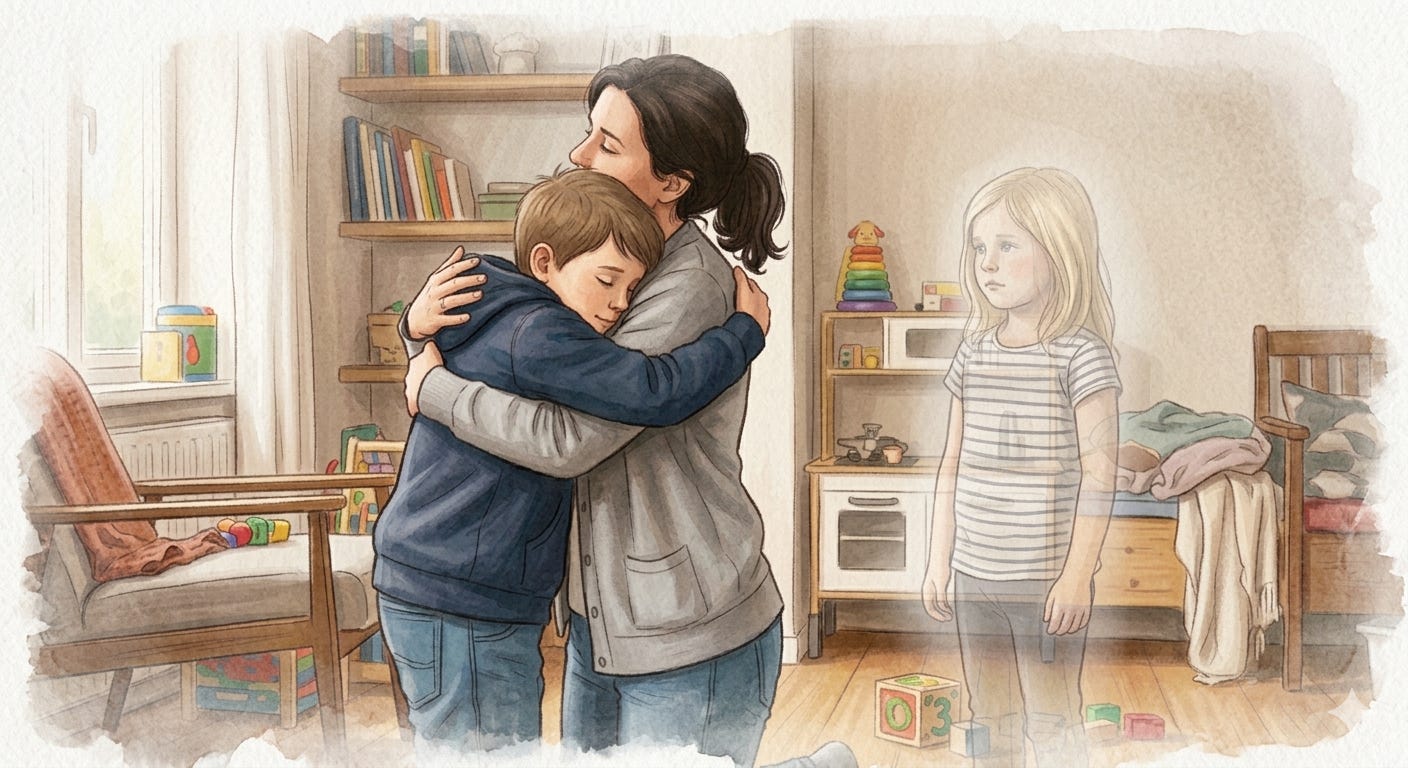
It’s Saturday afternoon. My kids are on the trampoline with the neighbour kids, someone’s brought balloons, and now there’s a game — the kind that evolves organically when you put six kids and some latex on a bouncy surface. Running, jumping, shrieking, keeping up.
My daughter can’t keep up.
She’s out of breath, struggling. And after a few minutes she peels off and comes inside, crying. Not because she’s hurt but because they kept playing without her.
And the thing is, they’re supposed to keep playing. They’re kids. I can’t stop the world from spinning at kid-speed just because her heart can’t match the pace. So I do what any parent (maybe?) would do - I offer her some iPad time as consolation, as a small softening of an unsolvable problem.
And then one of her siblings comes inside to use the bathroom, sees the iPad, and suddenly I’m managing a second crisis.
“Why does SHE get screen time?!!!”
And I’m explaining - again - something I don’t fully have words for.
What the Research Says (And What It Misses)
If you go looking for studies on siblings of kids with congenital heart disease like I did, good luck because wow there isn’t much.
The most comprehensive review I could dig up (Parker et al., 2020) identified only eleven studies — and half of them were conducted over twenty years ago and are adjacent without being completely dedicated to this issue. And the more recent work I could find (Amaro et al., 2026) pretty much acknowledged the same thing: siblings are chronically understudied. Validating, but not exactly encouraging.
What research does exist tends to focus on:
Fear of loss — siblings worrying their brother or sister might die
Disruption during hospitalizations — getting shuffled between relatives, missing school, life on pause
Feeling excluded — jealousy, resentment, less parental attention
Role changes — becoming helpers, protectors, little advocates who memorize medication lists
There are some positive findings, too: increased empathy, maturity beyond their years, stronger family bonds forged through crisis. But what’s missing from almost all of it? The daily friction. The neurological fallout. The behavioural patterns siblings don’t experience as “my sister has a heart condition” - they experience as “my sister is difficult and she also doesn’t have to take out the trash.”
The Two Threads We’re Not Hearing About
The Physical Limitations
The trampoline scene isn’t a one-off; it’s every birthday party where she fades before the other kids, every family hike calibrated to her capacity, every game that requires sustained exertion.
What her siblings see: she can’t keep up.
What they don’t see: the cardiac output that makes running genuinely harder. The oxygen saturation that dips when theirs stays steady. The fatigue that isn’t laziness but physiology.
And when accommodations follow (the iPad, the “you don’t have to carry the groceries,” the earlier bedtime) it looks like favouritism.
It’s not. But from three feet tall, it sure feels that way.
The Neurological Friction
This is the part nobody talks about. Like, really doesn’t.
My younger daughter comes upstairs crying, holding her arm. There’s a red handprint on it — her older sister’s. They’d been playing in the basement and something went sideways. The oldest escalated way past the situation and slapped her. Hard.
Now the oldest is screaming, crying, stomping up to her room, and the house is plunged into chaos. Again.

Was there provocation? Probably. Most likely. My younger daughter doesn’t back down. Plus, you know - siblings. Double plus - sisters. But the response was wildly disproportionate — impulsive, explosive, out of her control in the moment even though she knows hitting is absolutely not okay.
Or: we’re all at the table doing homework. She got another poor grade for turning something in late. We mention it calmly. She bursts into tears, yells, storms off. We have to call her back, have her sit and calm down, because blowing up at every perceived slight has become exhausting for everyone.
We’re walking on eggshells. All of us.
This is what her siblings live with:
Emotional dysregulation — reactions that don’t match the situation
Rigidity and controlling behaviour — things have to be her way or everything falls apart
Difficulty with flexible, back-and-forth play — the kind of spontaneous negotiation siblings do constantly
Impulsivity — striking out before thinking
The constant need for parental intervention
What her siblings see: She’s mean. She blows up. She gets away with it. And then the whole house reorganizes around HER meltdown while they’re standing there with a handprint on their arm.
What her siblings don’t see: The chain that connects her heart to her brain to these behaviours.
CHD → cardiopulmonary bypass → neurological impact → executive dysfunction → this.
They don’t know. We haven’t connected those dots for them. And honestly? I haven’t had the words myself.
The Fairness Problem
Here’s the crux of it all:
They understand intellectually. We’ve explained the medical reasons. We try to balance responsibilities in other ways. We acknowledge that it feels unfair without over-explaining.
And they still feel it’s unfair.
Because from their vantage point, it IS unfair. They didn’t ask for this either.
When the dust settles, this is what I hear:
“Why does she get to act like that?”
“Why do YOU always take her side?”
“It’s not fair that she gets [the iPad / the break / the attention].”
Or sometimes: nothing. They just withdraw. Shut down. What’s the point of saying anything?
The resentment builds — or doesn’t. Depends on the kid, depends on the day. Some push back vocally, some go quiet, and both responses make complete sense.
What We’re Trying
I wish I could give you a script. I don’t have one. Really wish I did, though.
But here’s what we do, depending on the day and the kid:
Explain the medical reasons directly
Try to balance responsibilities in other ways (she does plenty — more than her fair share in ways they don’t see)
Acknowledge it feels unfair without over-explaining
Let them vent without trying to fix it
Point out what she contributes when they’re only seeing what she “gets out of”
None of it is a magic formula. Some days it works, and on others everyone’s still mad.
The problem is: the dots aren’t connected for them.
They don’t know that her complex CHD (CCHD) affected her brain, that the behaviours they find so hard to live with are not conscious choices but downstream of something that happened before they were born.
Why haven’t we connected those dots?
Because I can tell you that I haven’t found the words. Not because I haven’t read the journals or because I don’t understand the mechanism. But translating “cardiopulmonary bypass causes neurological changes that affect executive function which manifests as emotional dysregulation and impulse control issues” into something an eight-year-old can hold (without it becoming a free pass or making their sister sound somehow broken)… that’s a different kind of translation.
One I haven’t cracked yet.
The Invisible Stuff (An Encore)
There’s something underneath all of this, the element I don’t talk about - don’t even want to think about. It’s just so much conflict. All the time. Yes, four kids will do that but this is different. The meltdowns. The eggshells. The constant refereeing.
My husband and I find ourselves checking out. Him on his phone during Family Movie Night. Me upstairs crocheting alone while the kids are in the living room together with their dad on Family Movie Night. We’re not proud of it. We’re just tired.
And then she’s at a friend’s house for the afternoon. And the house is... quieter. Noticeably so. And that’s when the guilt really hits - that it feels like a reprieve.
So I keep telling myself this: that’s not a betrayal of her. The dysregulation is exhausting for everyone — including her. And I see that, too. Its absence is noticeable because the friction is real.
What We Don’t Have Yet
The words.
The script for explaining to a child: “Here’s why your sister’s brain works this way. It’s connected to her heart. It’s not her fault. And it’s also okay for you to be frustrated. And no, I’m not taking her side. And yes, I see you too.”
The resources. The research. The acknowledgment that THIS (the daily texture of living alongside CCHD’s neurological wake) is what siblings actually experience.
Not fear of death. Fear of another meltdown at the dinner table.
The literature talks about siblings worrying about the heart, sure, but for a lot of us it’s often the CCHD brain our other kids are living with every day. And it doesn’t seem as if anybody has given any of us the language. There’s just no medical jargon for me to decode here.
What might help:
Space to complain without judgment — to say “my sister is SO annoying” without a parent swooping in with “but you know her heart...”
Eventually, other CCHD siblings to connect with. Not now — they’re too young. But someday.
And most of all: help finding the words. For them. For us. For all of it.
The Gap
This piece isn’t advice. I’m not standing on the other side of this with answers.
I’m standing in the middle of it, same as you.
But I know this: if you’re living this, you’re not alone. The silence around it — the gap between what the research studies and what your kitchen sounds like on a Tuesday afternoon — isn’t because you’re doing something wrong.
It’s because nobody’s looking at this yet.
Maybe it’s time we start.
If you’re living this — the daily friction, the fairness conversations, the exhaustion — I’d love to hear from you. What’s working? What words have you found? What do you wish someone had told you?
Comment below or reply to this email. We’re all figuring this out together.
Sources
Parker R, Houghton S, Bichard E, McKeever S. (2020). Impact of congenital heart disease on siblings: A review. Journal of Child Health Care, 24(2), 297-316. Link The most comprehensive review available — and it only found 11 studies, half over 20 years old. Good overview of what we know; better illustration of what we don’t.
Amaro CM, Alderfer MA, Wawrzynski SE, et al. (2026). Siblings of Young Children with Congenital Heart Disease: Parent Perspectives from a Crowdsourcing Study. Journal of Pediatric Psychology, 51(1), 44-54. Link Recent qualitative study using parent perspectives. Identifies themes of disrupted daily life, role changes, and the need for family-centered care that includes siblings.
Moon Y, Jung JW, Lee S. (2021). Sibling Relationships of Adolescents with Congenital Heart Disease. Int J Environ Res Public Health, 18(5), 2698. Link Korean study finding higher rivalry and power imbalance in CHD sibling relationships — and notably, rivalry INCREASES with age, opposite the typical pattern.
Medical Disclaimer
The content provided on Between the Beats is for informational and educational purposes only.
While I am deeply involved in the CHD community and the Canadian CHD Lived Experience Council, I am not a medical professional, doctor, or licensed healthcare provider. The insights, research translations, and personal experiences shared here are not intended to be a substitute for professional medical advice, diagnosis, or treatment.
Important Guidelines:
Consult Your Team: Always seek the advice of your cardiologist, surgeon, or other qualified health provider with any questions you may have regarding a medical condition or treatment plan.
Don’t Delay Care: Never disregard professional medical advice or delay seeking it because of something you have read on this Substack.
Emergency Situations: If you think you may have a medical emergency, call your doctor or local emergency services immediately.
By using this site, you acknowledge that you understand and agree to these terms.
My youngest daughter has HLHS. Her sister Addie is two years older. From the day she was born, Addie was shuttled between aunts and grandparents and we struggled with balance or lack thereof. One day Izzie (the youngest) was in a calendar with other heart kids and Addie said "I wish I had a heart defect so I could be in a calendar." I totally get where you are at. We heard the same arguments. Today, they are both teenagers and Addie understands more than she did when she was younger. We also got them involved with other heart families and siblings so they didn't feel alone. Izzie is followed by the cardio-neuro program and that has helped with her emotional issues, PTSD and deficits that CHD seems to take away in addition to cardiac output. I wish there was more research on siblings. Other heart moms helped us tremendously with how to help our kids understand their sister. I also love seeing Addie with other cardiac kids, when her sister goes to heart camp she plays with all the kids. Its a hard life and one I wouldn't have chosen but the silver linings are worth it.